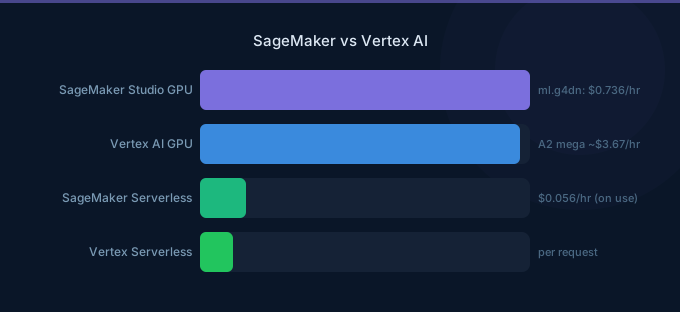
SageMaker and Vertex AI are the two dominant managed ML platforms. They cover similar ground — training, inference, notebooks, AutoML, pipelines, feature stores — but differ significantly in pricing models, instance selection, and ecosystem integration. Choosing between them affects your ML infrastructure costs by 20-50% depending on workload patterns.
This guide compares them across every dimension that matters for cost and capability: compute pricing, training options, inference flexibility, AutoML, MLOps tooling, and ecosystem strengths.
TL;DR: SageMaker offers broader instance selection (Spot training saves 60-70%, Inferentia chips for inference) and more flexible inference options (serverless, multi-model, async). Vertex AI has simpler pricing, tighter BigQuery integration, and better AutoML for tabular data. SageMaker is typically 10-30% cheaper for GPU-heavy workloads due to Spot and instance variety. Vertex AI wins on simplicity.
Training Cost Comparison
GPU Instance Pricing
| GPU | SageMaker Instance | SageMaker/hr | Vertex AI Machine | Vertex AI/hr |
|---|---|---|---|---|
| No GPU (CPU) | ml.m5.xlarge | $0.23 | n1-standard-4 | $0.19 |
| 1x T4 | ml.g4dn.xlarge | $0.74 | n1-standard-4 + T4 | $0.54 |
| 1x A10G | ml.g5.xlarge | $1.01 | g2-standard-4 | $0.83 |
| 4x A10G | ml.g5.12xlarge | $7.09 | g2-standard-48 | $5.87 |
| 1x A100 40GB | ml.p4d.24xlarge (8 GPUs min) | $37.69 | a2-highgpu-1g | $3.67 |
| 8x A100 80GB | ml.p4d.24xlarge | $37.69 | a2-ultragpu-8g | $29.39 |
| 8x H100 | ml.p5.48xlarge | $65.85 | a3-highgpu-8g | $62.68 |
| Trainium/TPU | ml.trn1.32xlarge | $21.50 | TPU v5e (8 chips) | $24.40 |
Key differences:
- SageMaker bundles GPU instances in fixed configurations (e.g., ml.p4d always has 8x A100). Vertex AI allows single-GPU A100 configurations ($3.67/hr for 1x A100 vs SageMaker's minimum 8x A100 at $37.69/hr).
- SageMaker offers Managed Spot Training (60-70% discount). Vertex AI supports preemptible VMs with similar discounts but less seamless integration.
- Vertex AI supports TPU v5e for training. SageMaker counters with Trainium (AWS custom silicon) at competitive pricing.
Spot/Preemptible Pricing
| Feature | SageMaker | Vertex AI |
|---|---|---|
| Discount | 60-70% | 60-91% |
| Integration | Native Managed Spot Training | Preemptible VMs (manual) |
| Checkpointing | Automatic | Manual setup required |
| Availability | Good for most instance types | Varies by region and GPU |
| Interruption handling | Managed by SageMaker | Must handle manually |
SageMaker's Managed Spot Training is significantly easier to use. Checkpointing, job resumption, and instance recovery are handled automatically. Vertex AI's preemptible VMs require more manual configuration for fault tolerance.
Inference Comparison
| Feature | SageMaker | Vertex AI |
|---|---|---|
| Real-time endpoints | Yes (per-second billing) | Yes (per-node-hour) |
| Serverless inference | Yes (scales to zero) | Yes (scales to zero) |
| Batch prediction | Batch Transform | Batch Prediction |
| Async inference | Yes (queue-based, scale to zero) | No native equivalent |
| Multi-model endpoints | Yes (share 1 instance) | No native equivalent |
| Auto-scaling | Target tracking, scheduled | Target tracking |
| Custom containers | Yes | Yes |
| GPU inference | Full GPU instance selection | Full GPU instance selection |
| Inferentia/TPU | Yes (Inferentia2 for inference) | Yes (TPU for inference) |
SageMaker advantages: Multi-model endpoints (host 10+ models on one GPU instance), async inference for large payloads, and Inferentia2 chips that offer 30-50% cost savings over GPUs for transformer inference.
Vertex AI advantages: Simpler auto-scaling configuration, tighter integration with BigQuery ML for serving BigQuery-trained models, and Model Garden for one-click deployment of foundation models.
AutoML Comparison
| Feature | SageMaker Autopilot/Canvas | Vertex AI AutoML |
|---|---|---|
| Tabular data | Good (Autopilot) | Excellent |
| Image classification | Supported | Excellent |
| Text classification | Supported | Excellent |
| Video classification | Limited | Supported |
| No-code interface | Canvas ($1.90/hr) | Vertex AI Console (free UI) |
| Training cost | Instance-hours | Node-hours |
| Explainability | SHAP values | Feature attributions |
| Edge deployment | SageMaker Neo | Vertex AI Edge |
Vertex AI AutoML is generally considered stronger for tabular data, with better automatic feature engineering and model selection. SageMaker Autopilot is competitive but Canvas ($1.90/hr workspace fee) adds cost that Vertex AI's console does not charge.
MLOps and Pipelines
| Feature | SageMaker Pipelines | Vertex AI Pipelines |
|---|---|---|
| Orchestration cost | Free | Free |
| Pipeline language | SageMaker Python SDK | KFP (Kubeflow Pipelines) SDK |
| Caching | Native step caching | Native step caching |
| Model Registry | Free, integrated | Free, integrated |
| Model Monitoring | $0.078/hr per endpoint | Included with endpoints |
| Experiment tracking | SageMaker Experiments | Vertex AI Experiments |
| A/B testing | Traffic splitting on endpoints | Traffic splitting on endpoints |
| CI/CD integration | CodePipeline, custom | Cloud Build, custom |
Both platforms offer free pipeline orchestration. The main cost difference is Model Monitor: SageMaker charges $0.078/hr per monitored endpoint, while Vertex AI includes basic monitoring with endpoints at no extra charge.
Feature Store Comparison
| Feature | SageMaker Feature Store | Vertex AI Feature Store |
|---|---|---|
| Online Store reads | $1.75/million | $0.36/million (Bigtable-backed) |
| Online Store writes | $7.45/million | $0.36/million |
| Online Store storage | $2.726/GB-month | $0.17/GB-month (Bigtable) |
| Offline Store | S3 ($0.023/GB) | BigQuery ($0.02/GB) |
| Batch serving | Athena/Spark | BigQuery (integrated) |
| Streaming ingestion | Kinesis/KDA | Dataflow |
Vertex AI Feature Store is significantly cheaper for online operations — roughly 5-15x less for reads and writes. This is because it is backed by Bigtable, which has lower per-operation costs than SageMaker's managed key-value store. For feature-heavy workloads, this difference can be substantial.
Data Labeling Comparison
| Feature | SageMaker Ground Truth | Vertex AI Data Labeling |
|---|---|---|
| Mechanical Turk integration | Yes | No |
| Private workforce | Free platform | Free platform |
| Vendor marketplace | Yes | Yes |
| Active learning | Yes (up to 70% auto-labeling) | Yes (similar capability) |
| Image labeling cost (MTurk) | $0.012/image | $0.035/unit (specialist) |
| 3D point cloud | Supported | Supported |
SageMaker Ground Truth with Mechanical Turk is generally cheaper for high-volume labeling. Vertex AI Data Labeling uses Google's specialist workforce which costs more per label but often delivers higher quality.
Real-World Cost Scenarios
Small Team (2 Data Scientists, 3 Models)
| Component | SageMaker | Vertex AI |
|---|---|---|
| Notebooks (2 users, 8hr/day) | $110 | $95 |
| Training (weekly, GPU, Spot/preemptible) | $48 | $65 |
| Inference (3 endpoints, mixed) | $993 | $1,050 |
| Monitoring | $7.20 | $0 |
| Total | $1,158 | $1,210 |
Mid-Size Operation (10 Models, Daily Retraining)
| Component | SageMaker | Vertex AI |
|---|---|---|
| Notebooks (5 users) | $883 | $740 |
| Training (daily, GPU, Spot/preemptible) | $550 | $750 |
| Inference (10 endpoints, auto-scaled) | $4,200 | $4,800 |
| Feature Store | $224 | $45 |
| Pipelines and monitoring | $57 | $0 |
| Total | $5,914 | $6,335 |
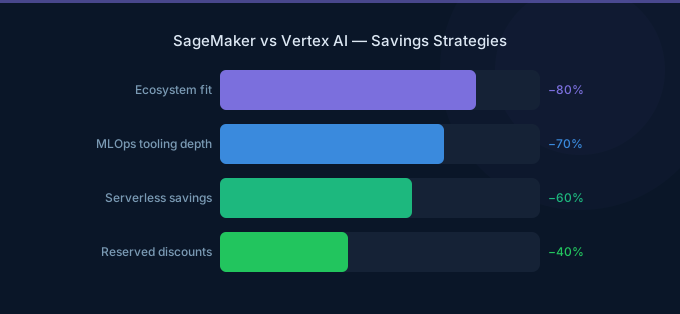
SageMaker tends to be 5-15% cheaper for GPU-heavy workloads due to Managed Spot Training's seamless integration and broader instance selection. Vertex AI compensates with cheaper feature store operations and included monitoring.
Cost Optimization Tips
-
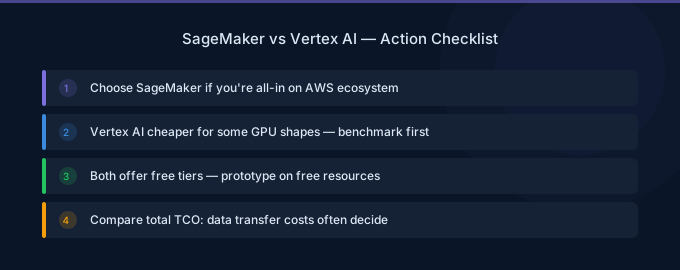
Choose based on your cloud ecosystem. If your data is in S3 and you use AWS services, SageMaker integrates most naturally. If your data is in BigQuery, Vertex AI avoids costly cross-cloud data transfer.
-
Leverage Spot/preemptible training aggressively. SageMaker Managed Spot is easier to use and saves 60-70%. Vertex AI preemptible VMs require more setup but offer similar savings.
-
Use platform-specific accelerators. SageMaker Inferentia2 saves 30-50% on inference vs GPUs. Vertex AI TPUs offer competitive training performance for supported models.
-
Compare single-GPU options for small models. Vertex AI allows a single A100 GPU ($3.67/hr). SageMaker's A100 option (ml.p4d) requires 8 GPUs minimum ($37.69/hr). For models that fit on one A100, Vertex AI is dramatically cheaper.
-
Factor in Feature Store costs for feature-heavy architectures. Vertex AI Feature Store is 5-15x cheaper per operation. If your workload involves hundreds of millions of feature lookups per month, this difference is material.
Related Guides
- AWS SageMaker Pricing: Training, Inference, Studio
- AWS SageMaker Cost Optimization: Cut ML Costs
- AWS Bedrock vs SageMaker
- AWS GPU Instance Pricing Guide
FAQ
Is SageMaker or Vertex AI cheaper?
It depends on the workload. SageMaker is typically 5-15% cheaper for GPU training (due to Managed Spot) and inference (due to multi-model endpoints and Inferentia). Vertex AI is cheaper for feature store operations (5-15x less), single-GPU A100 workloads, and includes monitoring at no extra charge. Total costs are usually within 10-20% of each other.
Can I use both SageMaker and Vertex AI?
Yes, but cross-cloud data transfer costs ($0.08-0.12/GB) make this expensive for data-heavy workloads. The practical approach is to choose one as your primary platform based on where your data lives. Some organizations use one for training and the other for specific inference scenarios.
Which platform has better AutoML?
Vertex AI AutoML is generally considered stronger for tabular data, with better automatic feature engineering. SageMaker Autopilot is competitive and improving. For image and text classification, both platforms deliver similar results. Canvas provides a better no-code experience but costs $1.90/hr for workspace sessions.
Lower Your SageMaker Costs with Wring
Wring helps you access AWS credits and volume discounts to lower your SageMaker costs. Through group buying power, Wring negotiates better rates so you pay less per instance hour.