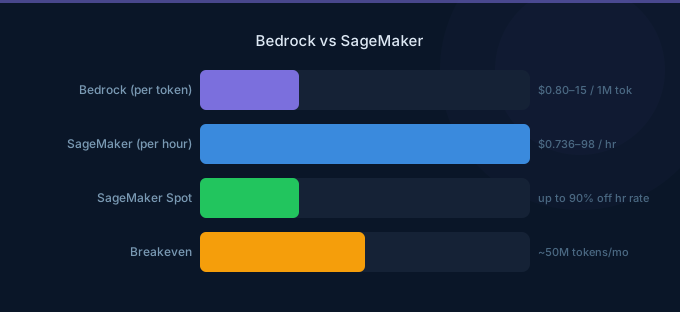
AWS offers two primary AI/ML platforms — Bedrock and SageMaker — that serve fundamentally different needs. Bedrock is an API layer for accessing foundation models without managing infrastructure. SageMaker is a complete ML platform for training, fine-tuning, and deploying custom models. Choosing the wrong one costs you either in unnecessary infrastructure management or in limited flexibility.
TL;DR: Use Bedrock when you want to build applications on top of existing foundation models (chatbots, RAG, summarization) without managing ML infrastructure. Use SageMaker when you need to train custom models, deploy open-source models with full control, or run ML pipelines for tabular/structured data. Many teams use both — Bedrock for LLM features, SageMaker for custom ML models.
Core Differences
| Dimension | Bedrock | SageMaker |
|---|---|---|
| Purpose | Managed API access to foundation models | Full ML lifecycle (train, tune, deploy) |
| Infrastructure | Fully managed, serverless | Managed instances you configure |
| Model access | Claude, Llama, Mistral, Titan, Stable Diffusion | Any model (HuggingFace, custom, open-source) |
| Custom training | Limited fine-tuning only | Full training from scratch |
| Pricing model | Per token/image | Per instance-hour |
| Minimum cost | $0 (pay per use) | $0.065/hr (smallest notebook instance) |
| Scaling | Automatic | Manual or auto-scaling endpoints |
| Setup time | Minutes | Hours to days |
Pricing Comparison
Scenario 1: Chatbot (1M conversations/month)
| Component | Bedrock (Claude Haiku) | SageMaker (Llama 70B self-hosted) |
|---|---|---|
| Compute | $2,400 (token-based) | $1,800 (ml.g5.2xlarge 24/7) |
| Infrastructure mgmt | $0 | Engineering time |
| Scaling | Automatic | Must configure |
| Total | ~$2,400/mo | ~$1,800/mo + ops |
Scenario 2: Document Processing (100K docs/month, batch)
| Component | Bedrock Batch | SageMaker Batch Transform |
|---|---|---|
| Compute | $1,800 (50% batch discount) | $900 (Spot instances) |
| Storage | Included | S3 costs |
| Total | ~$1,800/mo | ~$950/mo + ops |
Scenario 3: Custom Classification Model
| Component | Bedrock | SageMaker |
|---|---|---|
| Training | Fine-tuning only ($8/model unit-hr) | Full training ($1-50/hr depending on instance) |
| Inference | Per-token pricing | Endpoint pricing ($0.20-50/hr) |
| Flexibility | Limited model customization | Complete control |
| Best fit | Adapting a foundation model | Training on proprietary structured data |
When to Choose Bedrock
Choose Bedrock when:
- You want to add LLM capabilities to an existing application quickly
- Your use case is well-served by foundation models (chat, summarization, code generation, RAG)
- You don't have ML engineering expertise
- You need multiple model providers (Claude + Llama + Mistral) through one API
- You want built-in guardrails, knowledge bases, and agent orchestration
- Your workload is variable and you prefer per-token pricing over fixed instance costs
Bedrock excels at:
- Conversational AI and chatbots
- Document understanding and summarization
- Content generation and classification
- RAG (Retrieval-Augmented Generation) with Knowledge Bases
- Multi-step AI workflows with Agents
When to Choose SageMaker
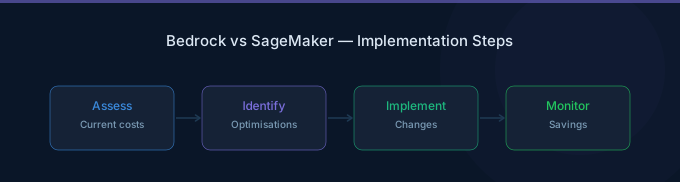
Choose SageMaker when:
- You need to train custom models on proprietary data from scratch
- Your ML workload involves tabular, time-series, or structured data
- You need full control over model architecture and hyperparameters
- You want to deploy open-source models with custom inference logic
- Cost optimization through Spot instances and custom hardware is important
- You have ML engineering expertise on your team
SageMaker excels at:
- Custom model training (computer vision, NLP, forecasting)
- MLOps pipelines with SageMaker Pipelines
- Hosting open-source models (HuggingFace, custom PyTorch/TensorFlow)
- A/B testing model versions with endpoint variants
- Distributed training across multiple GPUs
Using Both Together
Many organizations use Bedrock and SageMaker complementarily:
| Layer | Service | Example |
|---|---|---|
| User-facing LLM features | Bedrock | Chatbot, document Q&A |
| Custom ML models | SageMaker | Fraud detection, recommendation engine |
| Embeddings | Bedrock (Titan Embeddings) | Vector search for RAG |
| Fine-tuning foundation models | Either | Bedrock for simple, SageMaker for advanced |
| MLOps pipeline | SageMaker | Model retraining, monitoring, A/B tests |
Cost Optimization by Platform
Bedrock Cost Savings
- Use smaller models (Haiku over Opus) for simpler tasks
- Batch inference for 50% off on non-real-time processing
- Prompt caching for repeated system prompts
- Provisioned Throughput for sustained workloads
SageMaker Cost Savings
- Spot instances for training (60-90% savings)
- Serverless Inference for intermittent traffic
- Inference component for multi-model endpoints
- Graviton instances (ml.c7g, ml.m7g) for 20% lower cost
- Auto-scaling endpoints based on invocation metrics
Migration Paths
Bedrock to SageMaker
If Bedrock costs become too high at scale, you can:
- Export your fine-tuned model weights
- Deploy the same foundation model on SageMaker endpoints
- Gain instance-level control and Spot pricing
- Trade managed simplicity for cost savings
SageMaker to Bedrock
If SageMaker operational overhead is too high:
- Evaluate if foundation models meet your quality bar
- Migrate inference to Bedrock API calls
- Eliminate endpoint management
- Accept per-token pricing for zero-ops simplicity
Related Guides
- AWS Bedrock Pricing Guide
- AWS SageMaker Pricing Guide
- AWS SageMaker Cost Optimization Guide
- AWS Bedrock Fine-Tuning Guide
FAQ
Is Bedrock or SageMaker cheaper for LLM inference?
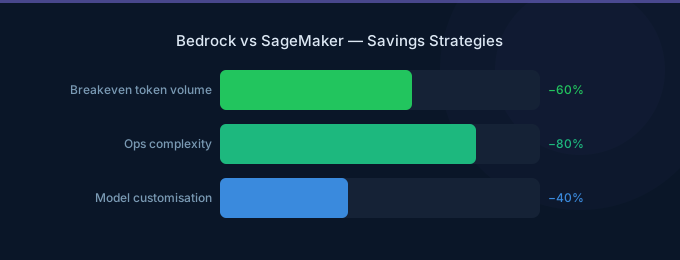
At low volume (under $3,000/month), Bedrock is cheaper because there's no idle instance cost. At high volume (over $5,000/month), SageMaker with dedicated instances and Spot pricing can be 30-50% cheaper — but requires ML engineering to manage.
Can I use SageMaker models from Bedrock?
Not directly. Bedrock only serves its curated model marketplace. You can, however, use SageMaker-hosted models alongside Bedrock models in the same application by calling different endpoints.
Do I need ML expertise for Bedrock?
No. Bedrock is designed for software engineers, not ML engineers. You call an API, send text, get a response. SageMaker requires understanding of model training, hyperparameters, instance sizing, and deployment patterns.
Lower Your AWS AI Costs with Wring
Wring helps you access AWS credits and volume discounts to lower your Bedrock and SageMaker costs. Through group buying power, Wring negotiates better rates so you pay less per model inference.