Total cloud spend tells you how much you're paying. Unit economics tells you whether that spending makes sense. A $50,000/month AWS bill means nothing in isolation. A $50,000/month bill serving 10,000 customers at $5/customer/month tells you exactly how your infrastructure scales with business growth — and whether your economics work.
Unit economics is the bridge between engineering and finance -- a core FinOps discipline. It answers the question every CFO asks: "Is our infrastructure spend proportional to our revenue, and will it improve as we scale?"
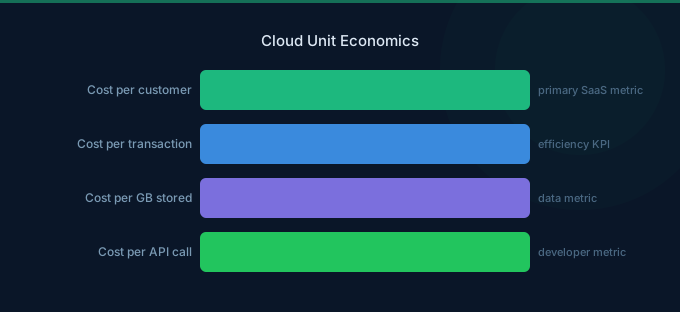
TL;DR: Unit economics metrics: cost per customer ($3-50/month depending on SaaS type), cost per transaction ($0.001-0.05), cost per API call ($0.00001-0.001), cloud as % of revenue (target under 15%). Track these monthly. They should improve over time — if cost per customer is rising, your architecture has scaling problems. The optimization goal: cloud costs should grow at 40-60% of the rate of business growth.
Core Unit Economics Metrics
Metric 1: Cost Per Customer
Formula: Monthly AWS spend / Monthly active customers
| SaaS Type | Healthy Range | Warning Signal |
|---|---|---|
| Low-compute (CRM, PM) | $2-8/customer | Over $15 |
| Standard B2B SaaS | $5-25/customer | Over $40 |
| Data/Analytics platform | $15-75/customer | Over $100 |
| AI/ML SaaS | $20-100/customer | Over $150 |
Track monthly. Cost per customer should trend downward as you scale — this demonstrates sub-linear infrastructure scaling, which is the basis of SaaS margin expansion.
Metric 2: Cost Per Transaction
Formula: Service-specific AWS cost / Number of transactions processed
Useful for: payment processors, marketplaces, logistics platforms — any business where value is measured in transactions.
| Business Type | Healthy Range |
|---|---|
| Payment processing | $0.001-0.005/transaction |
| E-commerce order | $0.01-0.05/order |
| API platform | $0.00001-0.001/call |
| Data pipeline | $0.001-0.01/record processed |
Metric 3: Cloud as Percentage of Revenue
Formula: Monthly AWS spend / Monthly revenue x 100
The executive-level metric. Benchmark by company stage and compare to industry averages.
Metric 4: Infrastructure Efficiency Ratio
Formula: Revenue growth rate / Cloud cost growth rate
| Ratio | Interpretation |
|---|---|
| Under 1.0 | Costs growing faster than revenue (bad) |
| 1.0-1.5 | Moderate efficiency |
| 1.5-2.5 | Good efficiency |
| Over 2.5 | Excellent efficiency (strong sub-linear scaling) |
How to Calculate Unit Costs on AWS
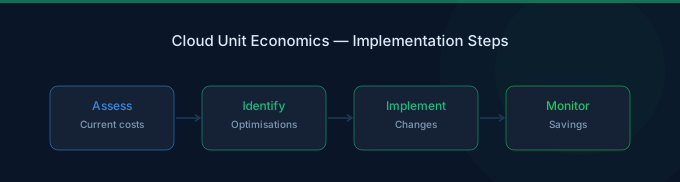
Step 1: Define Your Business Unit
Choose the unit that represents your business value:
- SaaS: Active customer or seat
- Marketplace: Transaction or order
- API platform: API call or request
- Data platform: GB processed or query executed
Step 2: Map AWS Costs to Business Units
Use AWS tags and Cost Explorer to attribute costs:
| AWS Service | Business Attribution |
|---|---|
| EC2/ECS/EKS | Application compute → divide by customers served |
| RDS/Aurora | Database → divide by customers (multi-tenant) or allocate per tenant (single-tenant) |
| S3 | Storage → allocate by tenant data volume |
| CloudFront | CDN → divide by monthly active users |
| Lambda | Functions → divide by invocations per business unit |
Step 3: Build the Dashboard
Create a monthly report tracking:
| Month | Revenue | AWS Spend | Cloud/Revenue | Active Customers | Cost/Customer |
|---|---|---|---|---|---|
| Jan 2026 | $200K | $30K | 15.0% | 2,000 | $15.00 |
| Feb 2026 | $220K | $31K | 14.1% | 2,200 | $14.09 |
| Mar 2026 | $240K | $32K | 13.3% | 2,400 | $13.33 |
This trend — improving efficiency every month — is what investors and executives want to see.
Common Unit Economics Problems
Problem 1: Linear Cost Scaling
Symptom: Costs grow at the same rate as customers. 2x customers = 2x cloud costs.
Root cause: Per-tenant resources (separate databases, dedicated instances), no caching, no shared infrastructure.
Fix: Migrate to multi-tenant architecture, add caching layers, consolidate compute.
Problem 2: Super-Linear Cost Scaling
Symptom: Costs grow faster than customers. 2x customers = 3x cloud costs.
Root cause: N+1 query problems, unindexed database queries, data that grows with the square of customers (social graphs, cross-customer analytics).
Fix: Database optimization, query indexing, architectural review of data models.
Problem 3: Flat Cost Per Customer
Symptom: Cost per customer stays constant as you scale — no efficiency gains.
Root cause: Right infrastructure choices but no commitment discounts, no Graviton adoption, no Spot utilization. The architecture scales well, but you're paying list price.
Fix: Implement Savings Plans, migrate to Graviton, use Spot for stateless workloads.
Problem 4: Falling Then Rising Cost Per Customer
Symptom: Cost per customer improved, then started increasing again.
Root cause: Usually a new feature (AI features, analytics, real-time processing) that changes the cost profile. Or a database hitting a scaling threshold that requires a larger instance tier.
Fix: Identify the new cost driver, optimize it specifically, update unit economics targets.
Making Unit Economics Actionable
For Engineering Teams
Show engineers how their architectural decisions impact unit costs:
- "This database change increases cost per customer by $0.50"
- "Switching to caching reduces cost per API call by 40%"
- "This AI feature adds $2/customer/month to infrastructure"
When engineers see costs in business terms, they make different design decisions.
For Finance Teams
Give finance the metrics they need for planning:
- Cost per customer enables infrastructure budget forecasting based on growth projections
- Cloud/revenue ratio shows efficiency trends for investor reporting
- Infrastructure efficiency ratio validates that growth is capital-efficient
For Executive Teams
Frame cloud optimization as business strategy:
- "Reducing cost per customer from $15 to $10 adds $500K/year to gross profit at current scale"
- "Our infrastructure efficiency ratio of 2.0 means revenue grows 2x faster than costs"
- "At 10,000 customers, our architecture scales more efficiently than competitors"
Related Guides
- Cloud Costs for SaaS: Benchmarks and COGS
- Cloud Tagging Strategy: Cost Management Foundation
- FinOps for Startups: Cloud Costs Without a Team
- What Is FinOps? Cloud Cost Management Guide
Frequently Asked Questions
What's a good cost per customer for SaaS?
It depends on your ARPU. Cloud cost per customer should be under 10% of ARPU. For a $50/month product, target under $5/customer. For a $500/month product, target under $30/customer. The ratio matters more than the absolute number.
How often should I measure unit economics?
Monthly at minimum. Track cost per customer, cloud/revenue ratio, and infrastructure efficiency ratio. Review quarterly with engineering and finance leadership. Include in board reporting if cloud costs exceed 10% of revenue.
What's the most important unit metric?
Cost per customer for most businesses. It ties infrastructure to the unit that generates revenue, enables forecasting, and benchmarks against industry averages. Cloud/revenue ratio is the executive summary metric, but cost per customer is more actionable.
How do I improve unit economics?
Two approaches: (1) Technical optimization — rightsizing, Graviton, Savings Plans, caching, multi-tenant architecture. (2) Architectural optimization — reduce cost per unit of business value through better design, shared infrastructure, and efficient data models. Technical optimization gives 20-40% improvement. Architectural optimization can give 2-5x improvement.
Build Unit Economics Into Your Culture
Unit economics transforms cloud costs from an engineering expense into a business metric. Start tracking today:
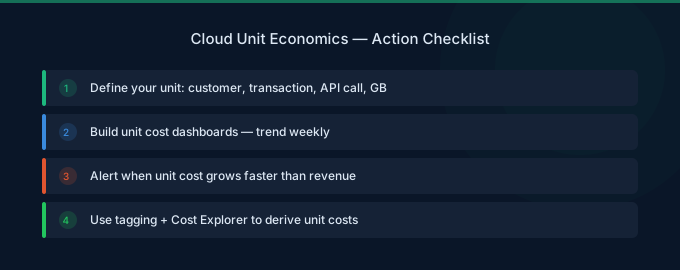
- Define your business unit — Customer, transaction, API call, or record
- Calculate current cost per unit — AWS spend divided by business units
- Set improvement targets — 5-10% reduction per quarter is achievable
- Track monthly — Build dashboards that connect AWS spend to business metrics
- Share broadly — Engineering, finance, and executives should all see unit economics
Lower Your Cloud Costs with Wring
Wring helps you access AWS credits and volume discounts to reduce your cloud bill. Through group buying power, Wring negotiates better per-unit rates across all AWS services.