For SaaS companies, cloud infrastructure isn't just an engineering cost -- it's COGS. Every dollar spent on AWS directly impacts your gross margin, which impacts your valuation. Understanding FinOps principles is critical for SaaS founders and CFOs. A SaaS company spending 25% of revenue on cloud has a fundamentally different unit economics profile than one spending 12%.
Investors, board members, and CFOs are paying attention. Cloud costs as a percentage of revenue is now a standard metric in SaaS due diligence. Optimizing it isn't just about saving money — it's about building a more valuable business.
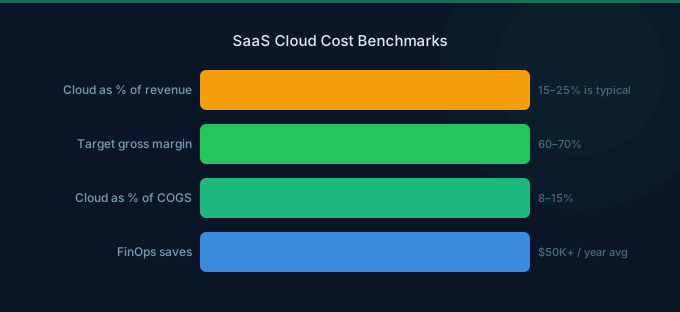
TL;DR: SaaS cloud cost benchmarks: seed stage 20-35% of revenue, Series A 15-25%, Series B+ 10-18%, public 8-12%. Cloud costs are COGS that directly impact gross margin. A 5% improvement in cloud efficiency on $10M ARR improves gross margin by $500K/year. Focus optimization on: multi-tenant efficiency, database cost per customer, compute scaling that matches revenue growth, and commitment discounts that improve with scale.
SaaS Cloud Cost Benchmarks
By Company Stage
| Stage | ARR | Typical Monthly AWS | Cloud as % Revenue | Target |
|---|---|---|---|---|
| Pre-revenue | $0 | $500-$5K | N/A | Minimize burn |
| Seed ($0-1M ARR) | Under $1M | $2K-$10K | 20-35% | Under 30% |
| Series A ($1-5M ARR) | $1-5M | $8K-$30K | 15-25% | Under 20% |
| Series B ($5-20M ARR) | $5-20M | $25K-$100K | 12-18% | Under 15% |
| Series C+ ($20-100M ARR) | $20-100M | $100K-$500K | 10-15% | Under 12% |
| Public | $100M+ | $500K-$5M+ | 8-12% | Under 10% |
By SaaS Type
| SaaS Category | Typical Cloud/Revenue | Why |
|---|---|---|
| Analytics/Data platforms | 20-30% | Compute-intensive, large data storage |
| AI/ML SaaS | 25-40% | GPU inference, model hosting |
| Standard B2B SaaS | 12-20% | Balanced compute/storage |
| Low-compute SaaS (CRM, PM tools) | 8-15% | Mostly database and API |
| Media/Video SaaS | 20-35% | Storage, CDN, transcoding |
Cloud Costs as COGS
Impact on Gross Margins
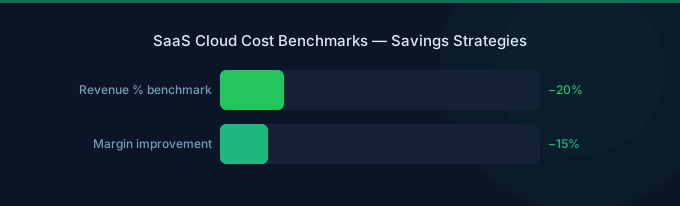
Cloud infrastructure is classified as Cost of Goods Sold (COGS) in SaaS financials. It directly reduces gross margin — the metric investors care most about.
| Metric | Company A | Company B |
|---|---|---|
| ARR | $10M | $10M |
| Cloud spend/year | $2.5M (25%) | $1.2M (12%) |
| Gross margin (before other COGS) | 75% | 88% |
| Impact on valuation (at 10x ARR) | Lower multiple | Higher multiple |
A 13% difference in cloud efficiency represents $1.3M/year in additional gross profit. At SaaS valuation multiples, that efficiency is worth $5-15M in enterprise value.
What Investors Look For
- Cloud costs growing slower than revenue — Efficiency should improve with scale
- Trending toward under 15% — Indicates the architecture scales efficiently
- Predictable cost structure — Costs should be proportional to usage, not spikey
- Commitment discount utilization — Shows financial sophistication
Unit Economics: Cost Per Customer
The most important SaaS infrastructure metric is cost to serve per customer (or per unit of usage). This tells you whether adding customers improves or degrades your economics.
Calculating Cost Per Customer
Total Infrastructure Cost Per Customer = Monthly AWS spend / Active customers
| Stage | Typical Cost/Customer/Month | Healthy Target |
|---|---|---|
| SMB SaaS ($50/mo ARPU) | $3-8 | Under $5 (under 10% of ARPU) |
| Mid-market ($500/mo ARPU) | $15-50 | Under $30 (under 6%) |
| Enterprise ($5K/mo ARPU) | $50-300 | Under $150 (under 3%) |
Tracking Cost Per Customer Over Time
The cost per customer should decrease as you scale — this is the efficiency gain that makes SaaS economics work. If cost per customer is flat or increasing, your architecture has scaling problems.
Common causes of rising cost per customer:
- N+1 query problems — Database queries that scale with data, not customers
- Per-tenant resources — Separate databases or instances per customer
- Unoptimized data growth — Storing everything forever without lifecycle policies
- Missing caching layers — Every request hits the database
SaaS-Specific Optimization Strategies
1. Multi-Tenant Database Efficiency
Single-tenant databases (one database per customer) are simple but expensive. Multi-tenant databases (shared database with tenant isolation) are 5-10x cheaper per customer.
| Architecture | Cost for 100 Customers | Cost for 1,000 Customers |
|---|---|---|
| Single-tenant (100 db.t4g.micro) | $1,450/mo | $14,500/mo |
| Multi-tenant (1 db.r7g.large) | $190/mo | $380/mo (2 instances) |
If you're still running single-tenant databases, migrating to multi-tenant is the single highest-impact SaaS optimization.
2. Caching Layer for Read-Heavy Workloads
Most SaaS applications are 80-90% reads. Adding ElastiCache (Redis/Valkey) between your application and database reduces database load, enabling a smaller database instance.
Typical savings: A $400/month RDS instance replaced by $200/month RDS + $50/month ElastiCache = $150/month savings + better performance.
3. CDN for Static Assets
SaaS applications often serve the same JavaScript, CSS, and images to every user. CloudFront CDN caches these at the edge, reducing origin server load and data transfer costs.
4. Background Processing for Heavy Operations
Reports, exports, bulk operations, and data processing should run asynchronously on cheaper compute (Fargate Spot, Lambda) rather than blocking your API servers.
5. Commitment Discounts at Scale
As monthly spend stabilizes, implement Savings Plans:
- Seed/Series A: Don't commit (too volatile)
- Series B: Commit 30-40% of baseline
- Series C+: Commit 50-60%, add Spot for stateless workloads
The SaaS Growth Efficiency Curve
Healthy SaaS companies show improving cloud efficiency as they scale:
| Revenue Growth | Cloud Cost Growth | Efficiency |
|---|---|---|
| 100% YoY | 100% YoY | Neutral (bad) |
| 100% YoY | 70% YoY | Good |
| 100% YoY | 40% YoY | Excellent |
Target: Cloud costs grow at 40-60% of the revenue growth rate. This indicates your architecture scales sub-linearly — the hallmark of healthy SaaS unit economics.
Related Guides
- Cloud Unit Economics: Costs to Business Outcomes
- FinOps for Startups: Cloud Costs Without a Team
- State of Cloud Costs: Trends and Benchmarks
- Cloud Rightsizing Guide: Stop Paying for Waste
Frequently Asked Questions
What percentage of revenue should SaaS spend on cloud?
Benchmark: 10-20% depending on stage. Early-stage (seed/Series A) companies typically spend 20-30% as they build. Growth-stage (Series B+) should target under 15%. Public SaaS companies typically run at 8-12%. Your target depends on SaaS type — data/ML-heavy products naturally spend more than simple CRUD applications.
How do cloud costs affect SaaS valuation?
Directly — through gross margin. Cloud costs are COGS, and every dollar saved goes directly to gross profit. At typical SaaS valuation multiples (5-15x ARR), a $500K/year cloud cost reduction can add $2.5-7.5M to enterprise value. Investors specifically look for improving cloud efficiency as a sign of sustainable unit economics.
When should a SaaS startup start optimizing cloud costs?
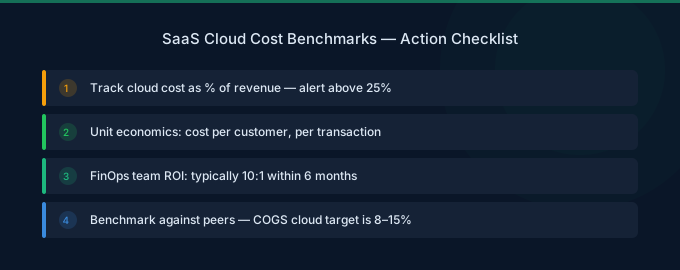
Start basic visibility from day one (AWS Budgets, cost alerts). Begin active optimization when: monthly spend exceeds $5K, cloud costs exceed 25% of revenue, or you're preparing for a fundraise. Investors will ask about infrastructure efficiency during due diligence.
How do I reduce cost per customer?
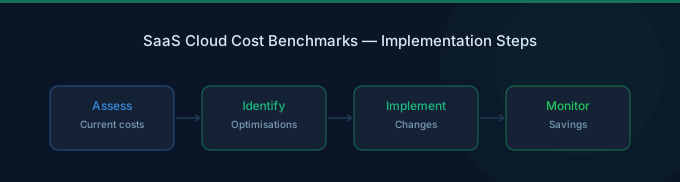
Three approaches: (1) Multi-tenant architecture — shared infrastructure across customers. (2) Caching — reduce database queries per request. (3) Lifecycle policies — don't store data forever. The goal is sub-linear cost scaling: 10x more customers should cost 3-5x more infrastructure, not 10x more.
Build Efficient SaaS Infrastructure
Cloud costs are a strategic lever for SaaS companies, not just an expense line. Optimize them to:
- Track cloud/revenue ratio — Benchmark against your stage and SaaS type
- Measure cost per customer — The unit metric that determines scalability
- Optimize architecture — Multi-tenant, caching, background processing
- Implement commitments at scale — Savings Plans when spend is predictable
- Show efficiency gains — Demonstrate improving cloud/revenue ratio to investors
Lower Your Cloud Costs with Wring
Wring helps you access AWS credits and volume discounts to reduce your cloud bill. Through group buying power, Wring negotiates better per-unit rates across all AWS services.