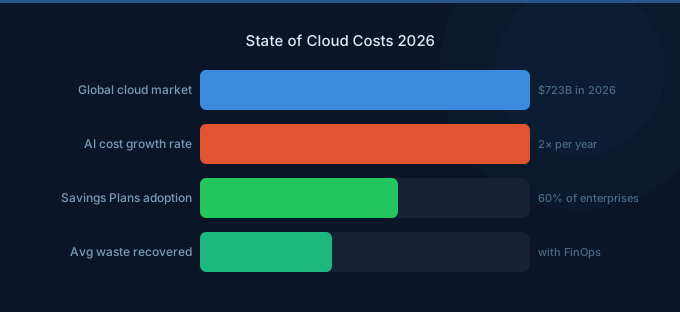
Cloud spending continues to grow according to the Flexera State of the Cloud Report, but the conversation has shifted. Three years ago, FinOps was about turning off idle instances and buying Reserved Instances. In 2026, the three forces reshaping cloud costs are: AI infrastructure spending that doubles annually, Kubernetes becoming the default deployment platform (with its own cost challenges), and commitment products that are increasingly sophisticated but harder to optimize.
This report covers what's changed, what the data says, and where organizations should focus their cost optimization efforts this year.
TL;DR: Cloud costs in 2026 are defined by three trends: (1) AI/GPU costs are the fastest-growing category, doubling YoY and now representing 15-25% of total spend for AI-adopting organizations. (2) Kubernetes cost management has emerged as a distinct discipline — clusters waste 30-40% through pod over-provisioning. (3) Commitment optimization has gotten more complex — Savings Plans, RIs, and Spot all have trade-offs that require portfolio management. Organizations that address all three areas save 35-55% versus those doing basic optimization only.
Trend 1: AI Costs Are the New Budget Wildcard
The defining cloud cost story of 2026 is AI. Inference API calls, GPU instances, and supporting infrastructure (vector databases, data pipelines) are the fastest-growing cost category for organizations with production AI deployments.
What the Data Shows
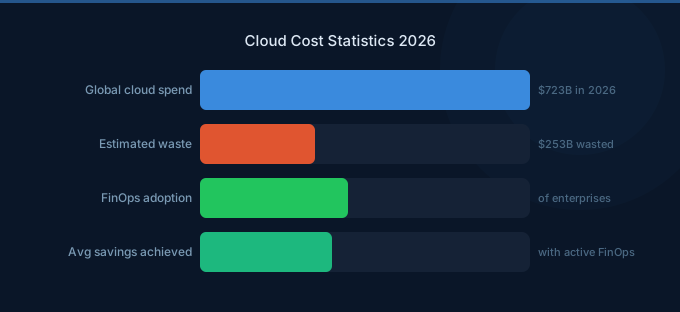
- AI infrastructure spending grows 85-100% year-over-year
- For organizations with production AI, these workloads represent 15-25% of total cloud spend
- 60-70% of AI spend goes to inference (API calls), not training
- GPU instance prices remain elevated due to demand
- Model efficiency improvements have reduced per-token costs 80-90% over two years
What's Changed From 2025
Model costs dropped dramatically. GPT-4o-mini at $0.15/$0.60 per million tokens makes AI accessible for tasks that were cost-prohibitive a year ago. Organizations are expanding AI use cases rapidly — which means total AI spend is growing even as per-unit costs fall.
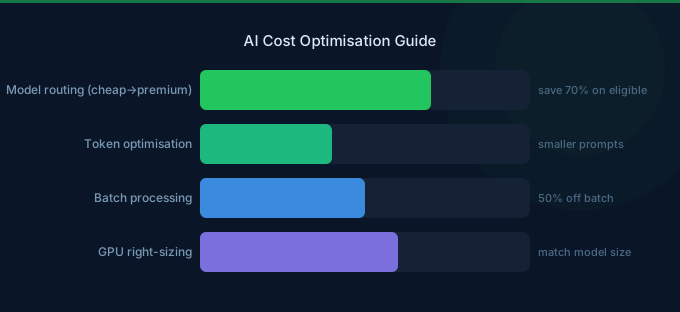
Multi-model strategies became standard. In 2025, most organizations used one model for everything. In 2026, multi-model routing — sending simple tasks to cheap models and complex tasks to expensive ones — is an established best practice that reduces inference costs 40-60%.
Self-hosting economics improved. Open models (Llama 3, Mistral) are competitive with proprietary models for many tasks. Combined with AWS Inferentia2 chips (50-70% cheaper than GPUs for inference), self-hosting is viable for high-volume workloads.
What to Do About It
- Implement multi-model routing if running AI at scale
- Track cost per inference and cost per business outcome
- Use batch processing for non-real-time AI workloads (50% savings)
- Evaluate self-hosting for workloads exceeding 1B tokens/month
Trend 2: Kubernetes Cost Management Matures
Kubernetes is now the default deployment platform for containerized workloads, but cost management has lagged adoption. That's changing in 2026.
What the Data Shows
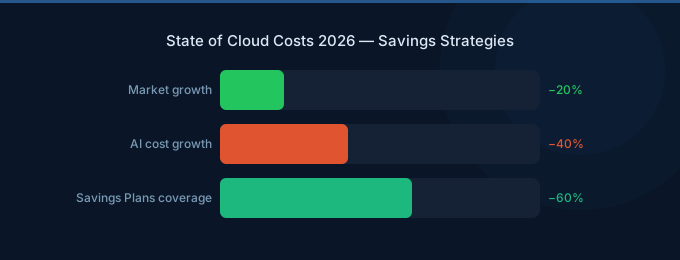
- Kubernetes clusters waste 30-40% of provisioned compute through pod over-provisioning
- Pod CPU requests exceed actual usage by 3-5x on average
- Karpenter adoption has grown to approximately 40% of EKS clusters (up from 15% in 2024)
- Namespace-level cost allocation is implemented in fewer than 30% of organizations
- Spot adoption for stateless K8s workloads remains under 25%
What's Changed From 2025
Karpenter became the default. AWS now recommends Karpenter over Cluster Autoscaler for new EKS clusters. Its ability to select optimal instance types, consolidate underutilized nodes, and diversify Spot instances provides 20-30% better cost efficiency.
Cost allocation tools improved. OpenCost (CNCF) and AWS Split Cost Allocation Data for EKS make namespace-level cost attribution practical without expensive third-party tools.
Pod rightsizing gained attention. The FinOps community now treats pod resource requests as a first-class optimization target, similar to EC2 rightsizing.
What to Do About It
- Deploy Karpenter if still using Cluster Autoscaler
- Implement VPA in recommendation mode for pod rightsizing data
- Tag namespaces for team-level cost allocation
- Move stateless workloads to Spot instances via Karpenter NodePools
- Set resource quotas per namespace to prevent budget overruns
Trend 3: Commitment Optimization Gets Complex
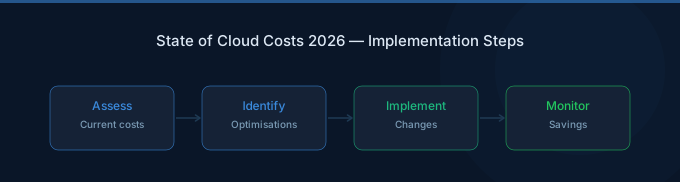
Savings Plans and Reserved Instances provide 30-72% savings, but optimizing a commitment portfolio requires more sophistication than ever.
What the Data Shows
- Savings Plans cover 45-55% of eligible workloads on average (leaving significant uncovered spend)
- Organizations with optimized commitment portfolios save 35-45% on committed resources
- 1-year No Upfront remains the most popular commitment (balancing savings with flexibility)
- Over-commitment (buying more commitments than usage) affects 15% of organizations
- Compute Savings Plans are preferred 3:1 over EC2 Instance Savings Plans due to flexibility
What's Changed From 2025
Commitment management is now portfolio management. Organizations are managing a mix of Compute Savings Plans, EC2 Instance Savings Plans, RDS Reserved Instances, and ElastiCache Reserved Nodes. Each has different terms, break-even points, and flexibility trade-offs.
Spot maturity increased. Organizations are using Spot more strategically — dedicated Spot fleets for stateless workloads, Spot for EKS nodes via Karpenter, and Spot for batch processing. This changes the commitment calculus: only On-Demand baseline should be committed.
Graviton adoption accelerated. Graviton instances are 20% cheaper with equivalent performance. As adoption reaches 30-35% of eligible workloads, it changes commitment sizing (lower dollar amounts needed for the same capacity).
What to Do About It
- Review commitment coverage quarterly (not annually)
- Commit to 50-60% of On-Demand baseline for safety margin
- Use Compute Savings Plans for maximum flexibility
- Don't commit Spot-eligible workloads — use Spot instead
- Factor in Graviton migration when sizing new commitments
Industry Benchmarks
Cloud Spend by Company Size
| Company Size | Average Monthly AWS Spend | Cloud as % of Revenue |
|---|---|---|
| Seed/Pre-revenue | $500-$5,000 | N/A (pre-revenue) |
| Series A ($1-5M ARR) | $5,000-$25,000 | 15-30% |
| Series B ($5-20M ARR) | $25,000-$100,000 | 12-22% |
| Series C+ ($20-100M ARR) | $100,000-$500,000 | 10-18% |
| Enterprise ($100M+ ARR) | $500,000-$5,000,000+ | 8-15% |
Spend by Service Category
| Service Category | Percentage of Bill |
|---|---|
| Compute (EC2, Lambda, Fargate, EKS) | 35-45% |
| Database (RDS, DynamoDB, Aurora) | 15-22% |
| Storage (S3, EBS, EFS) | 8-12% |
| Networking (Data Transfer, NAT, ALB) | 8-15% |
| AI/ML (Bedrock, SageMaker, GPUs) | 5-25% (growing fast) |
| Other (CloudWatch, SQS, etc.) | 5-10% |
Optimization Maturity Levels
| Maturity Level | Percentage of Orgs | Typical Waste | Key Gap |
|---|---|---|---|
| None (no optimization) | 20% | 40-50% | No visibility |
| Basic (alerts + rightsizing) | 35% | 25-35% | No commitments |
| Intermediate (commitments + automation) | 30% | 15-22% | No K8s/AI optimization |
| Advanced (full FinOps practice) | 15% | 8-15% | Continuous improvement |
What to Focus on in 2026
If You're Spending Under $50K/Month
- Quick wins first — Delete idle resources, rightsize, enable Savings Plans at 50% of baseline
- Graviton everywhere — 20% compute savings with minimal migration effort
- Basic AI cost tracking — If using Bedrock or OpenAI, instrument cost per call
- Budget alerts — Prevent bill shock before it happens
If You're Spending $50K-$200K/Month
- Formalize FinOps — Assign a FinOps champion (4-8 hours/month)
- Commitment portfolio — Optimize Savings Plans coverage to 60-70% of On-Demand baseline
- Kubernetes cost management — Deploy Karpenter, rightsize pods, implement Spot
- AI cost allocation — Tag and track AI costs separately from traditional infrastructure
- Team-level visibility — Each team should see their own cost dashboards
If You're Spending Over $200K/Month
- Dedicated FinOps hire — At this scale, a practitioner pays for themselves 5-10x over
- Advanced commitment management — Portfolio optimization across SPs, RIs, and Spot
- AI FinOps practice — Multi-model routing, token optimization, self-hosting evaluation
- Kubernetes deep optimization — Pod rightsizing, namespace budgets, cost allocation
- Architecture reviews — Monthly reviews of cost-intensive services for optimization opportunities
Related Guides
- Cloud Cost Statistics: 40 Key Data Points
- Cloud Waste Statistics: How Much Is Really Wasted?
- Cloud Costs for SaaS: Benchmarks and COGS
- What Is FinOps? Cloud Cost Management Guide
Frequently Asked Questions
How much should my company spend on cloud?
SaaS companies typically spend 10-25% of revenue on cloud infrastructure. Well-optimized companies keep this below 15%. If you're above 25%, there are significant optimization opportunities. Startups in hypergrowth may temporarily exceed these benchmarks, but should have a plan to optimize as growth stabilizes.
What's the biggest cloud cost trend in 2026?
AI infrastructure spending. It's the fastest-growing category (doubling annually) and the least optimized. Organizations are still figuring out how to manage per-token costs, GPU utilization, and AI cost allocation. Early adopters of AI FinOps practices are seeing 30-50% cost reductions.
How does our cloud spend compare to industry benchmarks?
Compare against the benchmarks in this report by company stage and revenue. More importantly, track your own optimization metrics: commitment coverage (target 60-70%), instance utilization (target over 40%), and cost per outcome (should improve over time). Your trajectory matters more than absolute numbers.
Benchmark and Optimize Your Spend
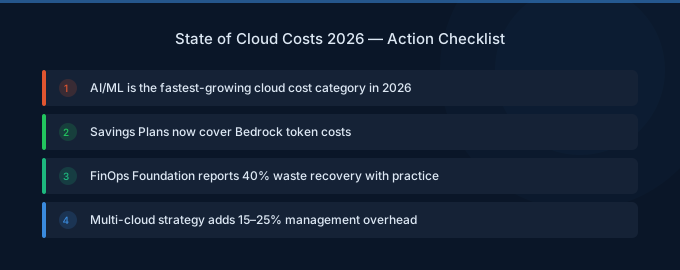
Cloud costs in 2026 reward organizations that manage the three new frontiers: AI costs, Kubernetes efficiency, and commitment portfolio optimization. The fundamentals haven't changed — you still need visibility, governance, and regular reviews — but the optimization surface has expanded significantly.
- Benchmark first — Compare your spend against the data in this report
- Identify your biggest gap — Is it AI costs, K8s waste, or commitment coverage?
- Prioritize by impact — Focus on the area with the largest dollar savings potential
- Build sustainable practice — FinOps is ongoing, not a one-time project
Lower Your Cloud Costs with Wring
Wring helps you access AWS credits and volume discounts to reduce your cloud bill. Through group buying power, Wring negotiates better per-unit rates across all AWS services.