AWS Redshift is Amazon's managed data warehouse service, handling petabyte-scale analytics. The pricing model changed significantly with RA3 instances that separate compute from storage and Redshift Serverless that eliminates capacity planning entirely. Understanding the three pricing tiers — DC2, RA3, and Serverless — determines whether you spend $2,000 or $20,000 monthly for similar workloads.
The biggest pricing mistake: running DC2 clusters 24/7 for workloads that only need a few hours of compute daily. Redshift Serverless or RA3 with pause/resume can cut these costs by 60-80%.
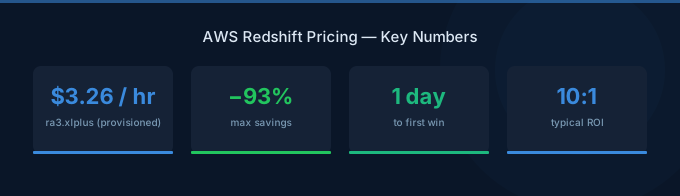
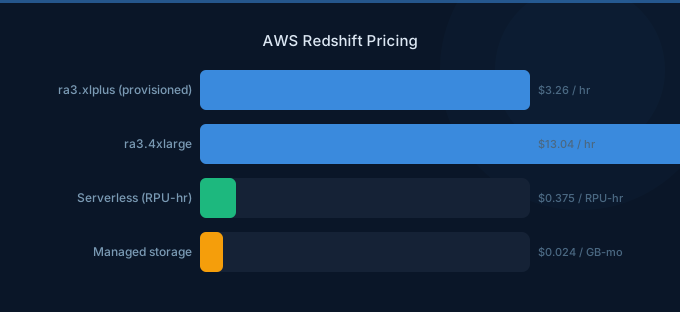
TL;DR: Redshift offers three options: DC2 nodes ($0.25/hr for dc2.large, fast local SSD), RA3 nodes ($3.26/hr for ra3.xlplus, managed storage at $0.024/GB/month), and Serverless ($0.375/RPU-hour, no capacity planning). For predictable workloads over 8 hours/day, use RA3 with Reserved Instances. For sporadic analytics, Serverless wins. DC2 is legacy — only use for datasets under 1 TB that need maximum performance.
Redshift Node Types and Pricing
RA3 Instances (Recommended)
RA3 separates compute from storage using Redshift Managed Storage (RMS).
| Instance | vCPUs | RAM | On-Demand/hr | Monthly (24/7) | Managed Storage |
|---|---|---|---|---|---|
| ra3.xlplus | 4 | 32 GB | $3.26 | $2,380 | $0.024/GB/mo |
| ra3.4xlarge | 12 | 96 GB | $9.78 | $7,140 | $0.024/GB/mo |
| ra3.16xlarge | 48 | 384 GB | $39.12 | $28,558 | $0.024/GB/mo |
Minimum cluster: 2 nodes. A 2-node ra3.xlplus cluster costs $4,760/month on-demand before storage.
DC2 Instances (Legacy)
DC2 uses local SSD storage — fast but storage is fixed to the node.
| Instance | vCPUs | RAM | Storage | On-Demand/hr | Monthly (24/7) |
|---|---|---|---|---|---|
| dc2.large | 2 | 15 GB | 160 GB SSD | $0.25 | $183 |
| dc2.8xlarge | 32 | 244 GB | 2.56 TB SSD | $4.80 | $3,504 |
Why DC2 is limiting: Storage is tied to compute. To get more storage, you must add nodes — even if you don't need more compute.
Redshift Serverless
No nodes to manage. You pay per RPU-hour of compute used.
| Component | Price |
|---|---|
| Compute | $0.375 per RPU-hour |
| Storage | $0.024 per GB/month |
| Base RPU | Minimum 8 RPUs |
| Idle cost | $0 (auto-pauses) |
Monthly estimate: 8 RPUs running 4 hours/day for 22 workdays = 8 x 4 x 22 x $0.375 = $264/month compute + storage.
Provisioned vs Serverless Cost Comparison
| Scenario | RA3 (2-node xlplus) | Serverless (32 RPU) |
|---|---|---|
| 24/7 usage | $4,760/mo | $8,640/mo |
| 12 hrs/day | $4,760 (no pause) or $2,380 (pause) | $4,320/mo |
| 4 hrs/day | $4,760 (no pause) or $793 (pause) | $1,440/mo |
| Sporadic (2 hrs/day) | $4,760 (no pause) | $720/mo |
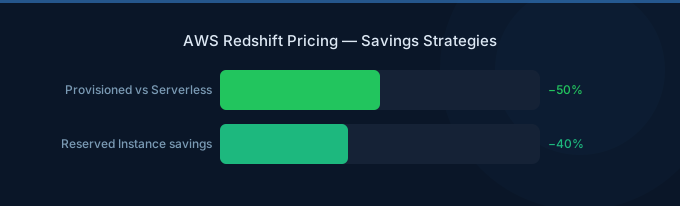
Key insight: RA3 with pause/resume is cheapest for predictable schedules. Serverless wins for unpredictable or light workloads.
Hidden Costs to Watch
Concurrency Scaling
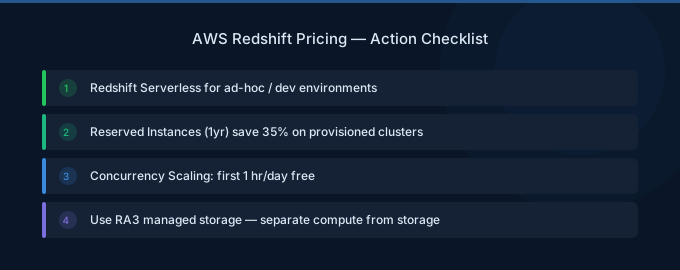
When queries exceed cluster capacity, Redshift adds transient clusters. Free for the first hour per day, then same per-second rate as your cluster.
Cross-AZ and Cross-Region Data Transfer
| Transfer Type | Cost |
|---|---|
| Same AZ | Free |
| Cross-AZ | $0.01/GB each way |
| Cross-Region | $0.02/GB |
| To Internet | $0.09/GB (first 10 TB) |
Spectrum (Query S3 Directly)
| Component | Cost |
|---|---|
| Spectrum queries | $5.00 per TB scanned |
| S3 storage | Standard S3 rates |
For infrequently queried historical data, Spectrum at $5/TB scanned is often cheaper than storing in Redshift at $0.024/GB/month.
Snapshots
| Storage | Cost |
|---|---|
| Automated snapshots (free storage equal to cluster size) | Free |
| Additional snapshot storage | $0.024/GB/month |
| Cross-region snapshot copy | $0.024/GB/month + data transfer |
Reserved Instance Savings
| Term | Payment | Discount |
|---|---|---|
| 1-year no upfront | Monthly | ~25% |
| 1-year partial upfront | Upfront + monthly | ~32% |
| 1-year all upfront | One payment | ~36% |
| 3-year partial upfront | Upfront + monthly | ~52% |
| 3-year all upfront | One payment | ~60% |
A 2-node ra3.xlplus cluster: $4,760/month on-demand drops to approximately $1,900/month with a 3-year all upfront RI.
Cost Optimization Strategies
1. Use Pause and Resume
RA3 clusters can be paused when not in use. You still pay for managed storage but stop compute charges. An 8-hour workday cluster costs 67% less than 24/7.
2. Right-Size with Elastic Resize
Start with fewer nodes and use elastic resize to add capacity during peak hours. This takes minutes, not hours like classic resize.
3. Partition and Sort Keys
Proper sort keys and distribution styles reduce the amount of data scanned per query, directly lowering Serverless costs and improving provisioned cluster performance.
4. Offload Cold Data to Spectrum
Move data older than 90 days to S3 and query via Spectrum at $5/TB. For 10 TB of cold data queried once monthly, Spectrum costs $50/month vs $240/month in RMS.
5. Use Concurrency Scaling Wisely
Monitor concurrency scaling usage. If it triggers frequently, your cluster is undersized — upgrading may be cheaper than the scaling surcharges.
Related Guides
- AWS Aurora Pricing Guide
- AWS Glue Pricing Guide
- AWS Kinesis Pricing Guide
- AWS S3 Pricing: Storage Classes and Hidden Costs
FAQ
Is Redshift Serverless cheaper than provisioned?
For workloads running under 6-8 hours daily, Serverless is typically cheaper. For 24/7 workloads, provisioned RA3 with Reserved Instances costs 50-70% less.
How does Redshift pricing compare to Snowflake?
Redshift Serverless at $0.375/RPU-hour is comparable to Snowflake credits. The key difference is that Redshift Managed Storage costs $0.024/GB/month vs Snowflake's $23/TB/month compressed. For storage-heavy workloads, Redshift is often cheaper.
Can I reduce Redshift costs without losing performance?
Yes. Implement sort keys, use RA3 managed storage instead of DC2, enable short query acceleration, and schedule pause/resume. Most teams reduce costs 30-50% with these changes alone.