AWS Timestream is a fully managed, serverless time-series database designed for IoT, DevOps monitoring, and analytics workloads. With pricing based on writes, queries, and storage across two tiers (memory and magnetic), Timestream costs depend on your ingestion rate, query patterns, and data retention policies.
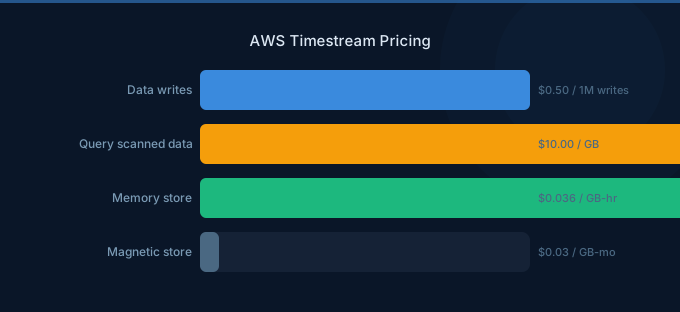
TL;DR: Timestream charges $0.50 per million 1 KB writes, $10.00 per GB of data scanned by queries, $0.036 per GB-hour for memory store, and $0.03 per GB-month for magnetic store. Query costs dominate for most workloads. Optimize by selecting specific measures, limiting time ranges, and setting aggressive retention policies.
Write Pricing
| Component | Price |
|---|---|
| Writes (1 KB each) | $0.50 per million |
| Multi-measure writes | $0.50 per million records |
| Write size | Each 1 KB = 1 write |
Each write represents a single data point up to 1 KB. Larger records are counted as multiple writes (rounded up to the next 1 KB). Multi-measure records let you bundle multiple measures into a single record, reducing write costs when you have many measures per timestamp.
Write Cost Example
An IoT application with 1,000 sensors sending data every 10 seconds:
- Writes per month: 1,000 sensors x 6/min x 60 min x 24 hrs x 30 days = 259.2 million
- Monthly cost: 259.2 x $0.50 = $129.60/month
Query Pricing
| Component | Price |
|---|---|
| Data scanned per query | $10.00 per GB |
| Minimum charge per query | 10 MB ($0.0001) |
| Cancelled queries | Charged for data scanned |
Query pricing is based on the amount of data scanned, similar to Athena. However, at $10/GB, Timestream queries cost twice as much per GB as Athena ($5/GB). Efficient queries that target specific time ranges and measures are essential for cost control.
Query Cost Example
Querying 30 days of data from 1,000 sensors (100 bytes per record):
- Data scanned: 1,000 x 6/min x 60 x 24 x 30 x 100 bytes = ~25.9 GB
- Query cost: 25.9 x $10.00 = $259 per query
- If running hourly dashboards: $259 x 720 queries = $186,480/month
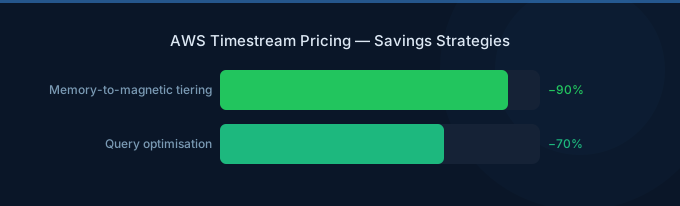
This example illustrates why query optimization is critical. Narrowing the time range and selecting specific measures can reduce scanned data by 90% or more.
Storage Pricing
Memory Store
| Component | Price |
|---|---|
| Memory store | $0.036 per GB-hour |
| Monthly equivalent | ~$26.28 per GB-month |
The memory store holds recent data for fast queries. Data in memory store is automatically organized for rapid retrieval. The retention period determines how long data stays in memory before transitioning to magnetic store.
Magnetic Store
| Component | Price |
|---|---|
| Magnetic store | $0.03 per GB-month |
| Late-arriving data writes | $0.50 per million |
Magnetic store provides cost-effective long-term storage at $0.03/GB-month. When data ages past the memory store retention period, it automatically moves to magnetic store. Queries against magnetic store data may be slightly slower but are billed at the same $10/GB rate.
Storage Tier Comparison
| Tier | Price per GB-month | Query Speed | Best For |
|---|---|---|---|
| Memory store | ~$26.28 | Fastest | Recent data, real-time dashboards |
| Magnetic store | $0.03 | Fast | Historical analysis, archival |
Real-World Cost Examples
| Use Case | Writes/Month | Storage | Queries | Monthly Cost |
|---|---|---|---|---|
| Small IoT (100 sensors) | 26M | 5 GB memory, 50 GB magnetic | 100 queries | $21 |
| DevOps monitoring (1K hosts) | 260M | 20 GB memory, 200 GB magnetic | 500 queries (1 GB each) | $5,143 |
| Industrial IoT (10K sensors) | 2.6B | 100 GB memory, 2 TB magnetic | 1,000 queries | $3,987 |
| Fleet telemetry (50K vehicles) | 13B | 500 GB memory, 10 TB magnetic | 2,000 queries | $20,400+ |
Timestream vs Alternatives
| Factor | Timestream | DynamoDB | InfluxDB on EC2 |
|---|---|---|---|
| Write cost (1M records) | $0.50 | $1.25 (1 WCU each) | EC2 instance cost |
| Query cost | $10/GB scanned | $0.25/million reads | EC2 instance cost |
| Storage (per GB-month) | $0.03 (magnetic) | $0.25 | EBS cost (~$0.08) |
| Management | Fully managed | Fully managed | Self-managed |
| Time-series functions | Built-in | Manual implementation | Built-in |
Timestream provides purpose-built time-series functions (interpolation, smoothing, aggregation) that would require custom code in DynamoDB. For high-query workloads, self-managed InfluxDB may be cheaper but requires operational effort.
Cost Optimization Tips
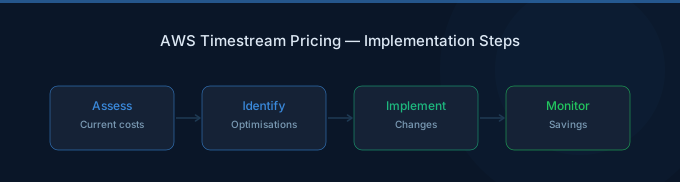
1. Set Aggressive Memory Store Retention
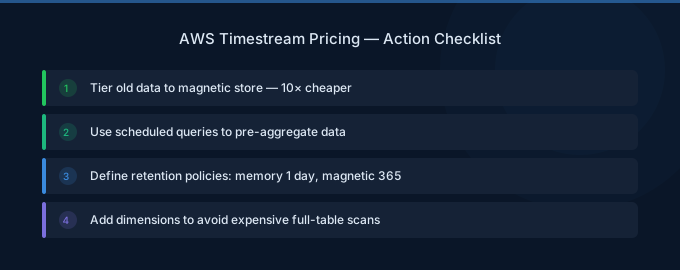
Memory store costs 875x more per GB than magnetic store. Keep only the most recent data in memory (e.g., 1-24 hours) and let older data transition to magnetic store automatically.
2. Use Multi-Measure Records
Bundle multiple measures into a single multi-measure record to reduce write costs. Instead of writing temperature, humidity, and pressure as three separate records, write them as one.
3. Query Specific Time Ranges and Measures
Always include WHERE time BETWEEN clauses and select only the measures you need. A query scanning 1 day instead of 30 days costs 30x less.
4. Set Magnetic Store Retention Policies
Configure magnetic store retention to automatically delete data beyond your analysis window. Storing 1 year vs 5 years of data at scale means the difference between hundreds and thousands of dollars in storage.
5. Batch Writes for Efficiency
Timestream supports batch writes of up to 100 records per request. Batching reduces API call overhead and can lower write costs when combined with multi-measure records.
Related Guides
- AWS DynamoDB Pricing Guide
- AWS RDS Pricing Guide
- AWS Kinesis Pricing Guide
- AWS CloudWatch Pricing Guide
FAQ
Is Timestream cheaper than DynamoDB for time-series data?
For write-heavy workloads, Timestream is cheaper ($0.50/million vs $1.25/million for DynamoDB on-demand). For read-heavy workloads, DynamoDB can be cheaper since reads are priced per request rather than per GB scanned. Timestream also offers built-in time-series functions that reduce application complexity.
Does Timestream have a free tier?
Timestream offers a limited free tier for the first 12 months: 50 million writes, 10 million query-scanned bytes, 1 GB of memory store, and 25 GB of magnetic store per month.
How do I estimate my Timestream query costs?
Use the EXPLAIN statement to see the estimated bytes scanned before running a query. Monitor the QueryBytesMetered CloudWatch metric to track actual query costs over time.
Lower Your Timestream Costs with Wring
Wring helps you access AWS credits and volume discounts to lower your Timestream costs. Through group buying power, Wring negotiates better rates so you pay less per GB scanned.