AWS Neptune is a fully managed graph database supporting both property graph (Gremlin, openCypher) and RDF (SPARQL) models. With pricing based on instances, storage, I/O, and backups, Neptune costs depend on your query complexity and data volume. Neptune Serverless offers automatic scaling for unpredictable workloads.
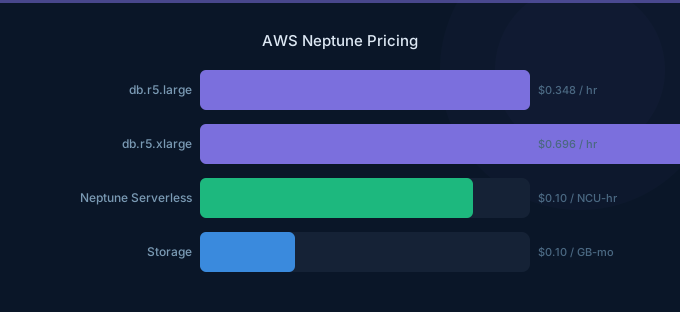
TL;DR: Neptune Provisioned starts at $0.348/hr for db.r5.large (~$254/month). Neptune Serverless charges $0.1098 per NCU-hour with automatic scaling from 1 to 128 NCUs. Storage costs $0.10/GB-month and I/O costs $0.20 per million requests. Use Serverless for variable workloads and Provisioned for steady, high-throughput graph queries.
Neptune Provisioned Instance Pricing
| Instance Type | vCPUs | Memory | Price/hr | Monthly (On-Demand) |
|---|---|---|---|---|
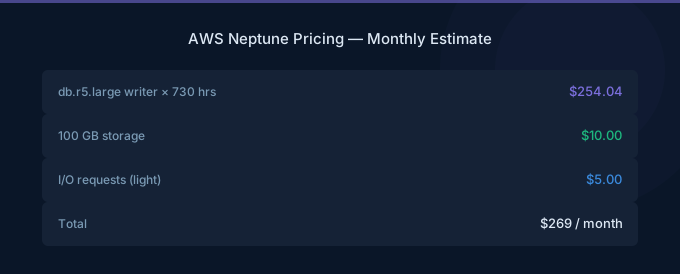
| db.r5.large | 2 | 16 GB | $0.348 | $254 |
| db.r5.xlarge | 4 | 32 GB | $0.696 | $508 |
| db.r5.2xlarge | 8 | 64 GB | $1.392 | $1,016 |
| db.r5.4xlarge | 16 | 128 GB | $2.784 | $2,032 |
| db.r5.8xlarge | 32 | 256 GB | $5.568 | $4,064 |
| db.r6g.large (Graviton) | 2 | 16 GB | $0.312 | $228 |
| db.r6g.xlarge (Graviton) | 4 | 32 GB | $0.624 | $456 |
Graviton-based (r6g) instances offer approximately 10% lower pricing than equivalent r5 instances with comparable or better performance for graph workloads.
Neptune Serverless Pricing
| Component | Price |
|---|---|
| Neptune Capacity Unit (NCU) hour | $0.1098/hr |
| Minimum NCUs | 1 NCU |
| Maximum NCUs | 128 NCUs |
| Scaling increment | 0.5 NCU |
Each Neptune Capacity Unit (NCU) provides approximately 2 GB of memory. Neptune Serverless automatically scales between your configured minimum and maximum NCUs based on query load. At minimum (1 NCU), the monthly cost is approximately $80.
Serverless Scaling Behavior
Neptune Serverless scales up within seconds when query demand increases and scales down during idle periods. You set minimum and maximum NCU bounds to control costs. For production workloads, a minimum of 2.5 NCUs (5 GB memory) is recommended.
Storage and I/O Pricing
| Component | Price |
|---|---|
| Storage | $0.10/GB-month |
| I/O requests | $0.20 per million |
| Backup storage (within retention) | Free |
| Backup storage (beyond retention) | $0.021/GB-month |
Storage Details
Neptune uses a distributed storage layer similar to Aurora. Storage is allocated in 10 GB increments and grows automatically up to 128 TB. You pay only for the storage consumed. Data is automatically replicated six ways across three Availability Zones.
I/O Costs
Every read and write operation against the storage layer incurs an I/O charge. Complex graph traversals that touch many nodes and edges generate significant I/O. A single multi-hop query can produce thousands of I/O operations. Monitor I/O costs closely, as they can exceed instance costs for read-heavy workloads.
Neptune Analytics Pricing
| Component | Price |
|---|---|
| Memory per hour | $0.111/GB-hr |
| Minimum | 16 GB |
| Minimum hourly cost | $1.776/hr |
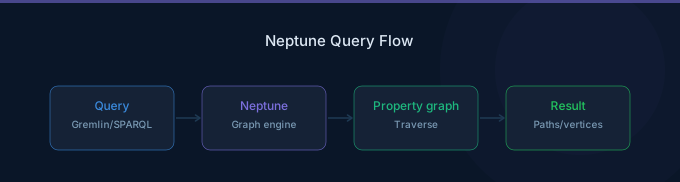
Neptune Analytics is an in-memory graph analytics engine for running algorithms like PageRank, shortest path, and community detection. It is priced separately from the Neptune database and is optimized for analytical queries on graph data.
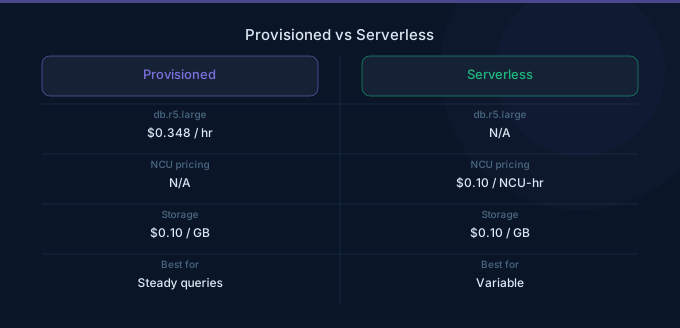
Provisioned vs Serverless Comparison
| Factor | Provisioned | Serverless |
|---|---|---|
| Minimum monthly cost | ~$254 (db.r5.large) | ~$80 (1 NCU) |
| Scaling | Manual instance changes | Automatic (1-128 NCUs) |
| Scale-down time | Minutes (instance change) | Seconds |
| Best for | Steady, predictable load | Variable, bursty queries |
| Reserved pricing | Yes (up to 45% savings) | No |
| Read replicas | Up to 15 | Up to 15 |
For development environments and applications with variable traffic patterns, Serverless eliminates over-provisioning. For production workloads with consistent query loads, Provisioned instances with Reserved pricing offer better value.
Real-World Cost Examples
| Use Case | Configuration | Monthly Cost |
|---|---|---|
| Dev/test | Serverless, 1-4 NCU | $80 - $320 |
| Small knowledge graph | db.r5.large, 50 GB storage | $259 |
| Social network graph | db.r5.2xlarge + 1 read replica, 500 GB | $2,082 |
| Fraud detection (production) | db.r5.4xlarge + 2 replicas, 1 TB I/O-heavy | $8,500+ |
| Variable API workload | Serverless 2.5-32 NCU, 200 GB | $400 - $2,700 |
Cost Optimization Tips
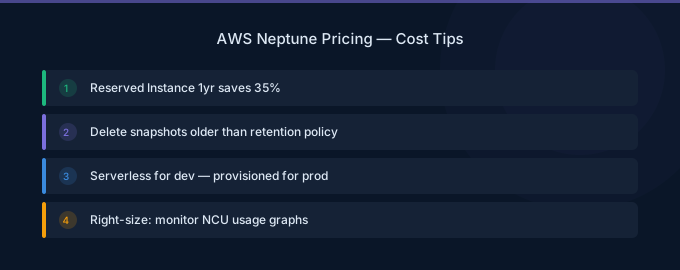
1. Use Graviton Instances
Graviton r6g instances provide 10% lower pricing than r5 equivalents. Switch to db.r6g.large for immediate savings with no code changes required.
2. Monitor I/O Costs Separately
I/O charges can become the largest cost component for traversal-heavy workloads. Use CloudWatch to track I/O operations and optimize queries to reduce the number of hops and edges traversed.
3. Use Read Replicas for Read-Heavy Workloads
Distribute read queries across up to 15 read replicas. Replicas use the same shared storage, so you pay only for the additional instance costs, not duplicate storage.
4. Apply Reserved Instance Pricing
For stable production deployments, Reserved Instances offer up to 45% savings compared to On-Demand pricing with 1-year or 3-year commitments.
5. Optimize Query Patterns
Avoid full-graph scans. Use indexed lookups, limit traversal depth, and filter early in your Gremlin or SPARQL queries. Well-optimized queries can reduce I/O costs by 80% or more.
Related Guides
- AWS RDS Pricing Guide
- AWS DynamoDB Pricing Guide
- AWS OpenSearch Pricing Guide
- AWS Bedrock Knowledge Bases Guide
FAQ
When should I use Neptune vs DynamoDB?
Use Neptune when your data has complex relationships that require multi-hop traversals, such as social networks, recommendation engines, or fraud detection graphs. Use DynamoDB for simple key-value or single-table access patterns where relationships are modeled as denormalized attributes.
Does Neptune have a free tier?
No. Neptune does not offer a free tier. The minimum cost is approximately $80/month for Neptune Serverless at 1 NCU or $254/month for the smallest Provisioned instance.
Can I use Neptune Serverless in production?
Yes. Neptune Serverless is production-ready and supports the same query languages (Gremlin, openCypher, SPARQL), features, and SLAs as Provisioned instances. It is well-suited for applications with variable or unpredictable query patterns.
Lower Your Neptune Costs with Wring
Wring helps you access AWS credits and volume discounts to lower your Neptune costs. Through group buying power, Wring negotiates better rates so you pay less per instance hour.