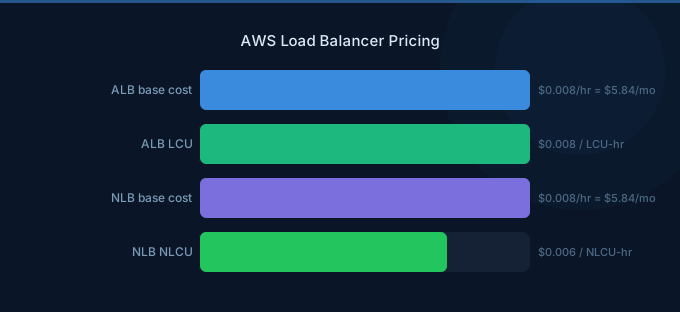
Every production application needs a load balancer, but AWS Elastic Load Balancing offers three types with different pricing models. Choosing wrong can cost you hundreds per month unnecessarily. The base hourly charge is the same across types ($0.0225/hour ≈ $16.43/month), but the capacity unit charges — where the real cost accumulates — differ significantly based on your traffic patterns.
The most common pricing mistake: running multiple ALBs when one ALB with host-based routing would suffice. See the ELB pricing page for current rates. Each ALB costs at least $22/month even with zero traffic.
TL;DR: All three ELB types cost approximately $22/month base. The variable cost comes from capacity units: ALB charges per LCU (new connections, active connections, bandwidth, rules), NLB charges per NLCU (connections, bandwidth, with lower per-connection costs for TCP). For HTTP/HTTPS traffic, use ALB. For TCP/UDP or extreme throughput, use NLB. Consolidate multiple ALBs with host-based routing to save $22/month per eliminated load balancer.
Load Balancer Type Comparison
| Feature | ALB | NLB | GWLB |
|---|---|---|---|
| Layer | 7 (HTTP/HTTPS) | 4 (TCP/UDP/TLS) | 3 (IP packets) |
| Base cost | $0.0225/hr ($16.43/mo) | $0.0225/hr ($16.43/mo) | $0.0125/hr ($9.13/mo) |
| Capacity unit | LCU | NLCU | GLCU |
| Capacity cost | $0.008/LCU-hour | $0.006/NLCU-hour | $0.004/GLCU-hour |
| Typical monthly | $22-100 | $22-80 | $12-50 |
| Best for | Web apps, APIs, microservices | TCP apps, gaming, IoT | Firewalls, inspection |
ALB Capacity (LCU) Dimensions
One LCU is the highest value across four dimensions per hour:
| Dimension | 1 LCU = |
|---|---|
| New connections | 25/second |
| Active connections | 3,000 concurrent |
| Bandwidth | 1 GB/hour |
| Rule evaluations | 1,000/second |
NLB Capacity (NLCU) Dimensions
| Dimension | 1 NLCU = |
|---|---|
| New connections/flows | 800/second (TCP), 400 (UDP) |
| Active connections/flows | 100,000 concurrent (TCP), 50,000 (UDP) |
| Bandwidth | 1 GB/hour |
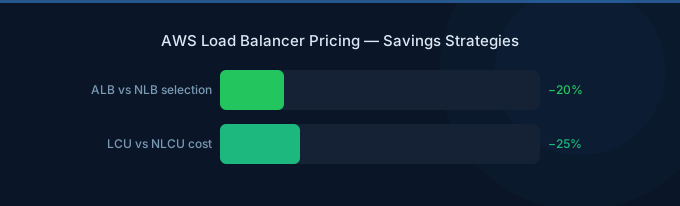
Key difference: NLB handles 32x more new connections per capacity unit than ALB (800 vs 25). For connection-heavy workloads, NLB is significantly cheaper.
Real-World Cost Examples
Small Web Application (1,000 req/min, 50 concurrent users)
| Component | ALB Cost |
|---|---|
| Base charge | $16.43/month |
| LCUs (~0.7 average) | $4.03/month |
| Total | $20.46/month |
Medium API Service (10,000 req/min, 500 concurrent connections)
| Component | ALB Cost | NLB Cost |
|---|---|---|
| Base charge | $16.43 | $16.43 |
| Capacity units | $23.36 (4 LCU avg) | $8.77 (2 NLCU avg) |
| Total | $39.79 | $25.20 |
NLB is cheaper for high-connection workloads, but you lose HTTP-level routing, sticky sessions, and WAF integration.
High-Traffic Production (100,000 req/min, 5,000 concurrent)
| Component | ALB Cost | NLB Cost |
|---|---|---|
| Base charge | $16.43 | $16.43 |
| Capacity units | $175+ (30+ LCU avg) | $52+ (12+ NLCU avg) |
| Total | $191+ | $68+ |
At high traffic volumes, the ALB capacity unit cost dominates. NLB is 3x cheaper, but only usable if you don't need Layer 7 features.
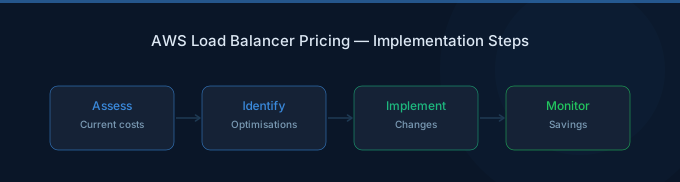
Optimization Strategies
1. Consolidate Load Balancers
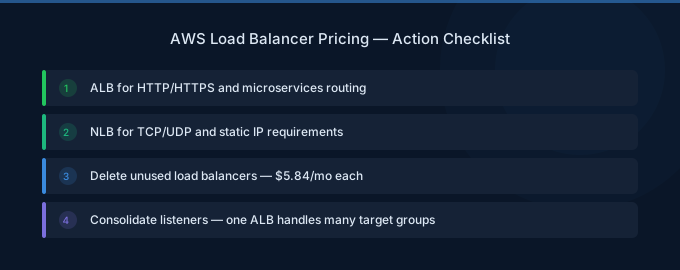
Each ALB costs minimum $22/month. Many organizations run one ALB per service when a single ALB with host-based routing can serve multiple services.
Before: 5 ALBs (one per microservice) = $110/month base After: 1 ALB with 5 host rules = $22/month base
Host-based and path-based routing rules let one ALB serve dozens of services. The first 10 rules are free; additional rules cost 1 LCU per 1,000 evaluations/second.
2. Choose the Right Type
- Use ALB for: HTTP/HTTPS traffic, REST APIs, WebSocket, gRPC, WAF integration, content-based routing
- Use NLB for: Pure TCP/UDP, extreme connection rates, static IP requirements, ultra-low latency
- Don't use GWLB unless: You need third-party virtual appliance inspection (firewalls, IDS/IPS)
3. Delete Unused Load Balancers
Load balancers without healthy targets or with zero request counts still cost $22/month. Check monthly:
- EC2 → Load Balancers → filter by "0 healthy targets"
- Cost Explorer → ElasticLoadBalancing → identify low-usage LBs
4. Use Internal ALBs for Service-to-Service
Internet-facing ALBs process traffic through the public network. For internal microservice communication, use internal ALBs — same pricing but no public IP costs and more secure.
5. Consider NLB for Kubernetes Ingress
For EKS clusters with high request rates, NLB as the ingress load balancer can be significantly cheaper than ALB due to lower capacity unit costs. Use the AWS Load Balancer Controller to provision NLB with Kubernetes Service type LoadBalancer.
Related Guides
Frequently Asked Questions
How much does an AWS load balancer cost per month?
The minimum cost is approximately $22/month (base charge with minimal traffic). Typical costs: $25-40/month for small applications, $50-100/month for medium traffic, $100-300/month for high-traffic production workloads. The base charge is fixed; capacity unit charges scale with traffic.
Which is cheaper, ALB or NLB?
NLB is cheaper for high-connection, high-throughput workloads because each NLCU handles 32x more connections than an ALB LCU. For typical web applications with moderate connection rates, the difference is small ($5-15/month). Choose based on features needed, not just price.
How many ALBs do I need?
Most organizations need fewer ALBs than they think. One ALB with host-based routing can serve dozens of services. You need separate ALBs only for: different VPCs, different security requirements (public vs internal), or when you hit the target group limit (100 per ALB).
Do I pay for idle load balancers?
Yes. Every load balancer charges the base hourly rate ($0.0225/hour ≈ $22/month) regardless of traffic. Load balancers with zero traffic, no targets, or only unhealthy targets still cost money. Delete any load balancer that isn't actively serving traffic.
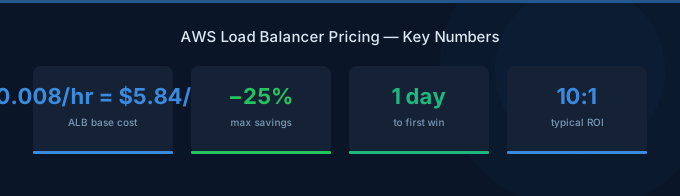
Right-Size Your Load Balancers
Load balancer costs are usually a small percentage of total infrastructure spend, but they add up when organizations over-provision:
- Consolidate ALBs — One ALB with routing rules instead of many
- Choose the right type — ALB for HTTP features, NLB for raw TCP performance
- Delete unused LBs — $22/month each adds up across accounts
- Monitor capacity units — Understand what drives your LCU/NLCU consumption
- Use internal LBs — For service-to-service communication
Lower Your Load Balancer Costs with Wring
Wring helps you access AWS credits and volume discounts to lower your load balancer costs. Through group buying power, Wring negotiates better rates so you pay less per hour.