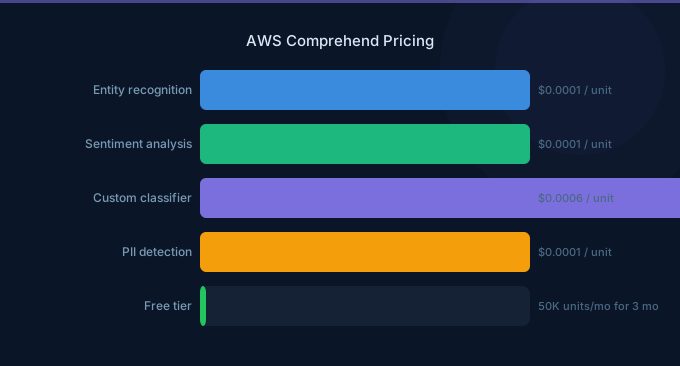
AWS Comprehend is a managed natural language processing service that extracts insights from text including sentiment, entities, key phrases, and language detection. With pricing measured in units (100-character increments), Comprehend offers pay-per-use NLP that scales from prototype to production without managing ML infrastructure.
TL;DR: NLP API requests cost $0.0001 per unit (1 unit = 100 characters, minimum 3 units per request). Custom classification training costs $3.00 per hour with inference at $0.0005 per unit. Free tier includes 50,000 units per month for 12 months. Batch processing short texts together to meet the 3-unit minimum reduces wasted spend.
NLP API Pricing (Built-in Models)
| Monthly Volume | Price per Unit |
|---|---|
| First 10 million units | $0.0001 |
| Next 40 million units | $0.00005 |
| Over 50 million units | $0.000025 |
One unit equals 100 characters of text. Each API request has a minimum of 3 units (300 characters), regardless of actual text length. A 50-character tweet is billed as 3 units. A 500-character paragraph is billed as 5 units.
These per-unit prices apply to the following NLP APIs:
- Entity Recognition - Detect people, places, organizations, dates, quantities
- Sentiment Analysis - Classify text as positive, negative, neutral, or mixed
- Key Phrase Extraction - Identify important phrases and concepts
- Language Detection - Identify the dominant language in text
- Syntax Analysis - Parse parts of speech and sentence structure
- Targeted Sentiment - Entity-level sentiment analysis
Batch vs Real-Time Processing
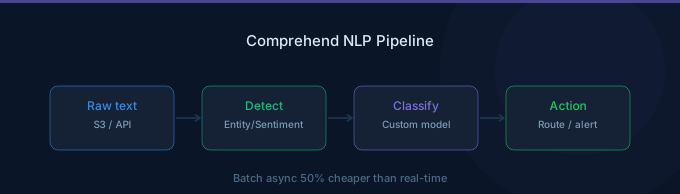
Both synchronous and batch API calls use the same per-unit pricing. However, batch processing through StartEntitiesDetectionJob reads documents from S3 and writes results to S3, reducing operational overhead for large-scale processing.
PII Detection and Redaction
| Operation | Price per Unit |
|---|---|
| PII detection (ContainsPiiEntities) | $0.0001 |
| PII entity identification (DetectPiiEntities) | $0.0001 |
PII detection identifies personally identifiable information such as names, addresses, Social Security numbers, and financial data within text. It uses the same unit-based pricing as other NLP APIs with the 3-unit minimum per request.
Custom Classification Pricing
| Component | Price |
|---|---|
| Model training | $3.00 per hour |
| Synchronous inference (endpoint) | $0.0005 per unit |
| Asynchronous inference (batch) | $0.0005 per unit |
| Endpoint management | Minimum 1 inference unit running |
Custom classification lets you train models to categorize text into your own custom categories. Training costs $3.00 per hour and typically takes 2-5 hours depending on dataset size. Each running inference endpoint has a minimum charge equivalent to 1 inference unit.
Custom Entity Recognition
| Component | Price |
|---|---|
| Model training | $3.00 per hour |
| Synchronous inference | $0.0005 per unit |
| Asynchronous inference | $0.0005 per unit |
Custom entity recognition follows the same pricing structure as custom classification. You train models to identify domain-specific entities (product names, medical terms, legal concepts) that the built-in entity recognition does not cover.
Topic Modeling Pricing
| Component | Price |
|---|---|
| Topic modeling job | $1.00 per 100 MB of text |
| Minimum charge | $1.00 (first 10 MB minimum) |
Topic modeling discovers abstract topics across a collection of documents. It requires a minimum of 10 MB of input text and is billed at $1.00 per 100 MB. A 500 MB corpus would cost $5.00 to process.
Free Tier
| Feature | Free Allowance | Duration |
|---|---|---|
| NLP APIs | 50,000 units/month | 12 months |
| Custom Classification (training) | 3 hours | One-time, 12 months |
| Custom Classification (inference) | 50,000 units/month | 12 months |
| Topic Modeling | 5 jobs (up to 1 MB each) | 12 months |
The Comprehend free tier provides 50,000 units per month (approximately 5 million characters) for the first 12 months. This is sufficient for prototyping and low-volume production workloads.
Real-World Cost Examples
| Use Case | Monthly Volume | Monthly Cost |
|---|---|---|
| Social media monitoring (sentiment) | 500K tweets (1.5M units) | $150 |
| Customer support ticket classification | 100K tickets (3M units) | $300 |
| Custom category classifier | 5hr training + 2M units inference | $1,015 |
| PII detection pipeline | 10M units | $1,000 |
| Enterprise NLP (multi-API) | 50M units across 3 APIs | $7,500 |
| Document topic analysis | 2 GB corpus | $20 |
Comprehend vs Alternatives
| Solution | Sentiment per 1M Characters | Custom Models |
|---|---|---|
| AWS Comprehend | $1.00 | $3/hr training + $0.0005/unit |
| Google Natural Language | $1.00 | $3/hr training + $5/1K queries |
| Azure Text Analytics | $1.00 | Custom pricing |
| AWS Bedrock (LLM-based) | $3-$15 (varies by model) | Prompt engineering only |
Cost Optimization Tips
1. Batch Short Texts to Minimize Unit Waste
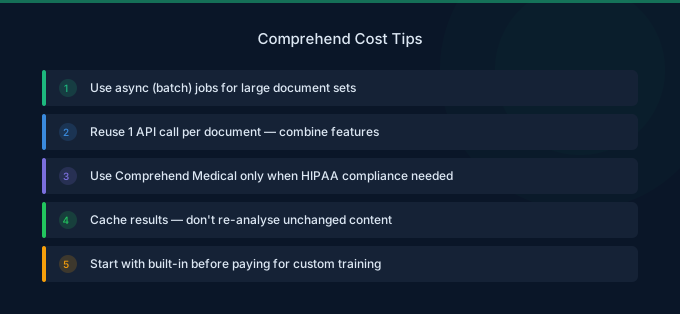
Every request has a 3-unit (300-character) minimum. If you are processing short texts like tweets (typically 100-200 characters), use the BatchDetectSentiment API which accepts up to 25 documents per call. This does not eliminate per-document minimums but reduces API call overhead.
2. Use Built-in APIs Before Custom Models
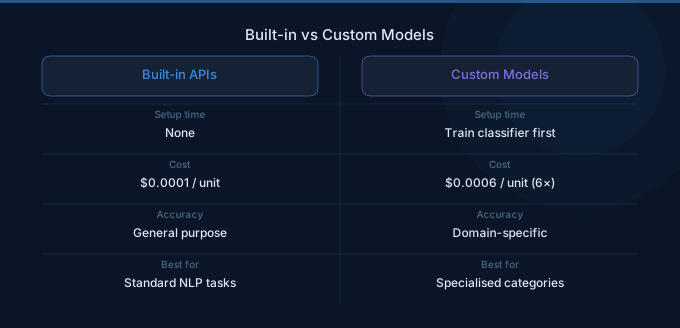
Custom model inference costs $0.0005 per unit, which is 5x more expensive than built-in APIs at $0.0001 per unit. Only invest in custom models when the built-in entity recognition or sentiment analysis does not meet your accuracy requirements.
3. Choose Async Over Sync for Batch Workloads
Asynchronous batch jobs process documents stored in S3 without requiring a running endpoint. For processing large document collections, async jobs are operationally simpler and avoid the ongoing cost of maintaining a real-time inference endpoint.
4. Monitor Unit Consumption with CloudWatch
Track your Comprehend API usage through CloudWatch metrics to identify unexpected volume spikes. Set billing alarms to catch runaway processes before they generate large charges.
5. Consider Bedrock for Complex Analysis
For nuanced text analysis that requires reasoning beyond entity extraction or sentiment classification, AWS Bedrock LLMs may provide better results with a single API call instead of chaining multiple Comprehend APIs together.
Related Guides
- AWS Bedrock Pricing Guide
- AWS Textract Pricing Guide
- AWS Lambda Pricing Guide
- AWS SageMaker Pricing Guide
FAQ
What is a Comprehend unit?
One unit equals 100 characters of UTF-8 text. Each API request is billed for a minimum of 3 units (300 characters), even if the input text is shorter. Whitespace and punctuation count toward the character total.
Can I run multiple NLP operations in a single API call?
No. Each NLP operation (sentiment, entities, key phrases) requires a separate API call, and each call is billed independently. Processing a document for both sentiment and entities costs 2x the unit charges. Evaluate which operations you truly need before running all of them.
How long does custom model training take?
Training time depends on dataset size and model type. A custom classifier with 10,000 training documents typically takes 2-4 hours ($6-$12 in training costs). Larger datasets with more categories can take up to 10 hours. Training is a one-time cost unless you retrain with new data.
Lower Your Comprehend Costs with Wring
Wring helps you access AWS credits and volume discounts to lower your Comprehend NLP costs. Through group buying power, Wring negotiates better rates so you pay less per unit processed.